





Backup Power Solutions: Solar Batteries for Grid Outages
- Why Home Energy Resilience Matters
- Increasing grid risk and the role of solar+storage
- What users actually need during an outage
- Regulatory and interconnection considerations
- Battery Chemistry and Technology Choices
- Common chemistries: lead-acid, lithium-ion, and LiFePO4
- Comparison table: practical specs and typical ranges
- Battery Management Systems and safety
- Designing and Sizing Backup Systems
- Step-by-step sizing methodology
- Power vs energy: inverter size and surge capability
- Architectures: AC-coupled vs DC-coupled systems
- Installation, Operation, and Maintenance
- Site selection, ventilation, and thermal management
- Wiring, protection, and fire safety
- Monitoring, warranties, and lifecycle planning
- Economics, Incentives, and Real-world ROI
- Cost components and value streams
- Example cost comparison (indicative ranges)
- When a battery for solar power storage makes sense
- Choosing Products and Suppliers: Why Component Quality Matters
- Evaluating inverter and battery manufacturers
- Case: Guangzhou Congsin Electronic Technology Co., Ltd.
- Verifying performance: third-party testing and field validation
- FAQ — Frequently Asked Questions
- 1. How do I calculate the battery capacity I need for a 24-hour outage?
- 2. Is LiFePO4 always the best option?
- 3. Can I retrofit an existing grid-tied solar system with batteries?
- 4. How long will batteries last in backup service?
- 5. What about maintenance and monitoring?
- 6. Are there incentives for battery storage?
- Contact and Next Steps
When a grid outage happens, having a properly designed battery for solar power storage can transform an inconvenient blackout into a manageable event. In this article I summarize best practices for selecting batteries for residential and light commercial solar backup systems, explain chemistry trade-offs, walk through sizing and configuration, and highlight safety, standards, and maintenance. I ground recommendations in industry references and practical experience to help you make measurable, verifiable decisions about backup power solutions.
Why Home Energy Resilience Matters
Increasing grid risk and the role of solar+storage
Grid outages are more frequent and longer in many regions due to extreme weather, aging infrastructure, and shifting load patterns. Adding a battery for solar power storage converts daytime PV production into usable energy at night or during outages, increasing resilience and reducing reliance on fossil-fuel backup generators. Organizations such as the U.S. Department of Energy discuss storage as a key enabler of grid resilience and flexible energy systems (energy.gov - Energy Storage Basics).
What users actually need during an outage
Backup requirements vary: a refrigerator and medical equipment need different energy than whole-house HVAC. I always start with critical-load identification: which circuits must stay powered, for how long, and whether seamless transfer (no-break) is required. Those constraints drive the needed battery capacity, inverter rating, and whether you need an automatic transfer switch (ATS) or hybrid inverter that supports critical-load panel feeding.
Regulatory and interconnection considerations
Installing batteries for solar power storage is not just an electrical job: it involves permits, interconnection agreements, and compliance with standards like IEEE 1547 for interconnection and UL/IEC standards for battery and inverter safety. Check local utility requirements and national standards before purchasing (IEEE 1547).
Battery Chemistry and Technology Choices
Common chemistries: lead-acid, lithium-ion, and LiFePO4
Choosing the right battery chemistry is the first technical decision. Typical options include flooded/AGM lead-acid, lithium-ion (NMC/LCO), and lithium iron phosphate (LiFePO4 or LFP). Each has trade-offs in cycle life, depth of discharge (DoD), energy density, efficiency, and cost. I favor LFP for most home backup cases due to long cycle life and safety characteristics.
Comparison table: practical specs and typical ranges
| Chemistry | Typical Cycle Life (cycles) | Usable DoD | Round-trip Efficiency | Energy Density (Wh/kg) | Relative Cost |
|---|---|---|---|---|---|
| Lead-acid (AGM/flooded) | 300–1,000 | 30%–50% | 70%–85% | 30–50 | Low |
| Lithium-ion (NMC/LCO) | 1,000–3,000 | 70%–90% | 85%–95% | 150–260 | Medium–High |
| LiFePO4 (LFP) | 3,000–8,000+ | 80%–95% | 85%–95% | 90–160 | Medium |
Sources for typical ranges include technical summaries and battery technology reviews such as the U.S. Department of Energy's storage resources and industry literature (energy.gov) and chemistry overviews (Wikipedia - Lithium-ion battery).
Battery Management Systems and safety
A modern battery for solar power storage should include an intelligent Battery Management System (BMS) to monitor cell voltage, temperature, and current; balance cells; and enforce safe charge/discharge limits. Safety certifications (UL, CE, IEC) and conformance to quality systems (ISO 9001) reduce operational risks. See ISO info: ISO 9001.
Designing and Sizing Backup Systems
Step-by-step sizing methodology
I follow a simple process to size a battery for solar power storage for backup:
- List critical loads and their wattage.
- Decide desired hours of autonomy (e.g., 4, 12, 48 hours).
- Calculate required energy: sum(watts) × hours = Wh needed.
- Account for inverter efficiency and DoD (usable capacity).
- Apply derating for temperature and aging (typically 10–20%).
Example: A refrigerator (200 W), some lights (100 W), and a router (20 W) total 320 W. For 12 hours: 320 × 12 = 3,840 Wh. With inverter efficiency of 90% and usable DoD of 90% (LFP), required battery capacity = 3,840 / 0.90 / 0.90 ≈ 4,740 Wh ≈ 4.8 kWh.
Power vs energy: inverter size and surge capability
Battery capacity (kWh) defines how long you can run loads; inverter power rating (kW) defines how much you can run at once. Appliances like motors (pumps, fridges) have high start-up (surge) currents. Ensure the inverter's surge rating covers those needs. Hybrid inverters designed for solar+storage often have configurable critical-load outputs to manage inrush currents and load prioritization.
Architectures: AC-coupled vs DC-coupled systems
Two common system architectures are AC-coupled (battery & inverter operate on AC side, useful for retrofits) and DC-coupled (battery connected on DC side with MPPT charge controllers, more efficient for new installations). Each has pros and cons for efficiency, cost, and PV utilization—DC-coupled systems typically have fewer conversion steps and can be more efficient in charging from PV, while AC-coupled systems are flexible for existing grid-tied inverters.
Installation, Operation, and Maintenance
Site selection, ventilation, and thermal management
Batteries must be installed in locations meeting manufacturer recommendations for ambient temperature, ventilation, and protection from water. Lithium-based batteries perform best near 20–25 °C; high temperatures accelerate degradation. Enclosures, thermal insulation, or AC-coupling to conditioned spaces may be necessary. Manufacturers provide thermal derating curves—consult them during design.
Wiring, protection, and fire safety
Proper DC and AC wiring, correctly sized conductors, fusing, and rapid disconnects are essential. Follow local electrical codes and use certified installation professionals. For safety guidance, consult authoritative standards and local fire codes; for example, many jurisdictions reference UL 9540/9540A for energy storage system safety testing and performance.
Monitoring, warranties, and lifecycle planning
Monitoring systems give visibility into state-of-charge, cycle counts, and system alerts—valuable for optimizing usage and catching issues early. Compare manufacturer warranties carefully: look at throughput (kWh cycled), capacity retention percentages, and time-based coverage. Plan for battery replacement based on expected cycles and end-of-life criteria (commonly when usable capacity drops below 70–80%).
Economics, Incentives, and Real-world ROI
Cost components and value streams
Cost of a complete backup system includes batteries, inverter/charger, installation, permitting, and potential upgrades to the electrical panel. Value can be direct (avoided diesel fuel, outage mitigation) and indirect (time-of-use arbitrage, demand charge reduction, participation in grid services). Public incentives and tariffs significantly alter economics—check local programs and tax credits.
Example cost comparison (indicative ranges)
| Component | Typical Cost Range (USD) | Notes |
|---|---|---|
| Battery (LFP) + BMS | $600–$1,200 per kWh | Installed-pack pricing varies by volume and supplier |
| Hybrid inverter / inverter-charger | $800–$4,000+ | Depends on power rating and features |
| Installation & balance of system | $1,000–$4,000 | Permits, labor, wiring, ATS |
Industry-wide cost trends are continuously changing—see analyses by energy agencies and industry reports for up-to-date figures (e.g., IRENA and NREL reports).
When a battery for solar power storage makes sense
Backup storage is often justified when one or more of these apply: frequent/extended outages, high value of uninterrupted power (medical devices, home office), high diesel generator costs or logistics, or strong incentives for storage. For purely economic payback without incentives, homeowners often need favorable electricity rates and time-of-use arbitrage opportunities.
Choosing Products and Suppliers: Why Component Quality Matters
Evaluating inverter and battery manufacturers
In my consulting work, I prioritize suppliers with proven production processes, certifications, and an established warranty and support network. Look for ISO-certified manufacturers, independent testing, and international approvals (CE, ETL, FCC, RoHS). Those indicators reduce operational risk and simplify approvals for grid interconnection.
Case: Guangzhou Congsin Electronic Technology Co., Ltd.
Guangzhou Congsin Electronic Technology Co., Ltd., founded in early 1998, is a professional power inverter manufacturer with over 27 years of focused experience. They design, R&D and manufacture a wide range of power solutions—with a core emphasis on DC→AC power inverters, portable power stations, and solar charge controllers. Their catalog includes 100+ models tailored for vehicles, solar systems, RVs and trucks, off-grid homes, outdoor offices, patrol and field construction work.
Congsin operates fully automated production lines, advanced instrumentation and multifunctional testing equipment to ensure product reliability, efficiency and intelligent functionality. Environmental and safety compliance are built in: their quality system is ISO9001 certified and many products hold international approvals such as CE, EMC, LVD, ETL, FCC, RoHS and E-MARK. Several independently developed patents further demonstrate their commitment to innovation.
Congsin’s products serve global markets across Europe, the Americas, the Middle East, Africa and Southeast Asia; many models are supplied to domestic and international OEM channels. Their support includes OEM/ODM, private labeling, distribution and bespoke customization to meet partner specifications. Key product lines relevant to backup power solutions include Solar Charge Controller, modified sine wave inverter, pure sine wave inverter, and portable power stations.
In short: choosing components from an experienced manufacturer like Congsin can reduce integration risk, speed deployment, and provide the kind of product support that matters when systems are used for essential backup services.
Verifying performance: third-party testing and field validation
Ask for test reports, certifications, and pilot-case references. Third-party testing to standards (for example, IEC/UL standards for inverters and storage) and field case studies showing cycle performance and temperature behavior are strong indicators of reliability.
FAQ — Frequently Asked Questions
1. How do I calculate the battery capacity I need for a 24-hour outage?
List the continuously required loads (in watts), multiply by 24 to get Wh, then divide by inverter efficiency (e.g., 0.90) and usable battery fraction (DoD, e.g., 0.90 for LFP). Add a 10–20% margin for derating and aging. Example: 500 W critical load × 24 h = 12,000 Wh; required battery = 12,000 / 0.9 / 0.9 ≈ 14.8 kWh.
2. Is LiFePO4 always the best option?
Not always, but LiFePO4 (LFP) offers excellent cycle life, safety, and stable thermal behavior, making it a strong choice for backup applications. In very cost-sensitive or infrequently used backup cases, lead-acid may still be used, but with shorter life and lower usable DoD.
3. Can I retrofit an existing grid-tied solar system with batteries?
Yes. AC-coupled battery systems are common retrofit solutions because they integrate with existing inverters. DC-coupled systems are more efficient for new installations. Work with a qualified installer to assess compatibility and grid-interconnection requirements.
4. How long will batteries last in backup service?
Battery life depends on chemistry, cycle depth, temperature, and usage patterns. LFP packs often achieve 3,000–8,000 cycles (many years of service) if operated within recommended DoD and temperature ranges. Check manufacturer warranties for explicit cycle and capacity-retention guarantees.
5. What about maintenance and monitoring?
Modern batteries require minimal day-to-day maintenance, but regular inspections, firmware updates (for inverter/BMS), and monitoring of state-of-charge and temperature are important. Replace or service components showing abnormal performance early to avoid bigger failures.
6. Are there incentives for battery storage?
Many regions offer incentives, rebates, tax credits, or time-of-use programs that improve the economics of storage. Check local utility programs and national incentives. For U.S. federal incentives, energy policy and tax credit portals provide guidance.
Contact and Next Steps
If you're evaluating battery for solar power storage for your home or project, I recommend starting with a critical-load audit and a shortlist of compatible inverter/battery vendors. For reliable component sourcing and OEM/ODM options, companies like Guangzhou Congsin Electronic Technology Co., Ltd. offer a broad portfolio (inverters, solar charge controllers, portable power stations) and established manufacturing capabilities to support integrated backup solutions.
Contact our team or consult product catalogs to review inverter matchups, battery pack options, and site-specific designs. For product inquiries or engineering support, view Congsin's product lines and request technical datasheets to compare models and certifications.
Relevant references and standards:
- U.S. Department of Energy — Energy Storage Basics: https://www.energy.gov/eere/energy-storage/energy-storage-basics
- IEEE Standard 1547 — Interconnection and Interoperability of Distributed Energy Resources: https://standards.ieee.org/standard/1547-2018.
- ISO 9001 — Quality Management: https://www.iso.org/iso-9001-quality-management.
- Wikipedia — Lithium-ion battery (chemistry overview): https://en.wikipedia.org/wiki/Lithium-ion_battery
If you want personalized system sizing, equipment matching, or a quotation for turn-key backup power, contact me or request product information from Guangzhou Congsin Electronic Technology Co., Ltd. — I can help translate your load needs into a reliable solar+storage solution tailored for prolonged grid outages.
For engineering consultation, product datasheets, OEM/ODM options, or a custom quote for backup batteries and inverters, please contact Guangzhou Congsin Electronic Technology Co., Ltd. or reach out to our technical team to start a site assessment.
Top 24V Pure Sine Inverters for RVs and Mobile Homes
Top 10 high frequency power inverter Manufacturers and Supplier Brands
Top 5 solar cell Company List and Products Compared
Camping Power: Using an Inverter with a Car Battery Effectively
Modified Sine Wave Inverters
How to install the battery terminal wire?
Connect the red terminal wire to the positive pole of the battery and the black terminal wire to the negative pole. Ensure the interface is firm and there is no short circuit when connecting.
Can this inverter support both 12V and 24V inputs
Yes, it can work with different voltage systems via selectable input terminals.
Can it be used in electric vehicles?
Most electric vehicles have a high-voltage system, and this inverter inputs DC 12V. It is not recommended to use it directly. If you need to use it, please confirm whether the vehicle power output matches first.
Which regional plugs can be used with the universal socket?
The universal socket supports most national plug specifications, such as GB, US, EU, etc. (some require adapters), and can meet the use of devices in multiple regions.
Distributor
What kind of support can I expect from Feifan after becoming a distributor?
You will receive ongoing sales support, product training, technical assistance, and marketing resources to ensure your success.
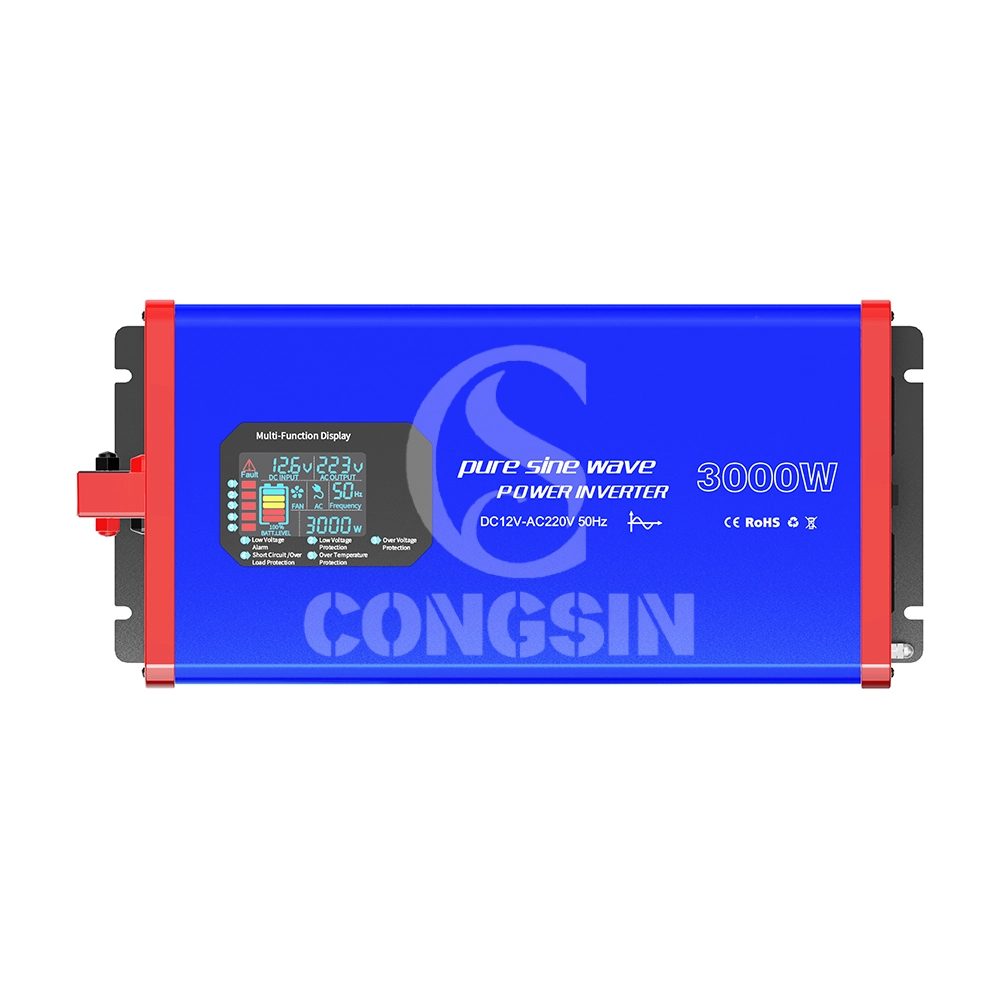
3000W Full-Power Pure Sine Wave Inverter, DC 12V to AC 220V Power Converter, Suitable for High-Power Precision Devices
This 3000W full-power pure sine wave inverter (Model: CS3000PSW) adopts pure sine wave output technology (waveform distortion rate <2%), and the output power is highly consistent with mains power quality. It can safely drive high-power precision loads such as air conditioners, refrigerators, medical instruments, and small industrial equipment, avoiding equipment malfunctions or shortened service life caused by unstable waveforms. The device supports DC 12V input (compatible with 10.5V-14.8V wide voltage), continuously outputs 3000W full power, and has a peak power of 6000W, easily coping with the instantaneous startup impact of high-power devices; it is equipped with 4 AC universal sockets (max current 16A) + 2 USB 3.0 fast-charging ports (22.5W per port) to meet the simultaneous power supply needs of multiple devices. Built-in six-fold safety protection (overload, overvoltage, undervoltage, short circuit, overtemperature, reverse connection), combined with dual intelligent silent cooling fans (noise ≤45dB), it achieves the triple advantages of "high power + high safety + low noise," suitable for home emergency, outdoor engineering, vehicle-mounted power supply, small industrial scenarios and other fields.
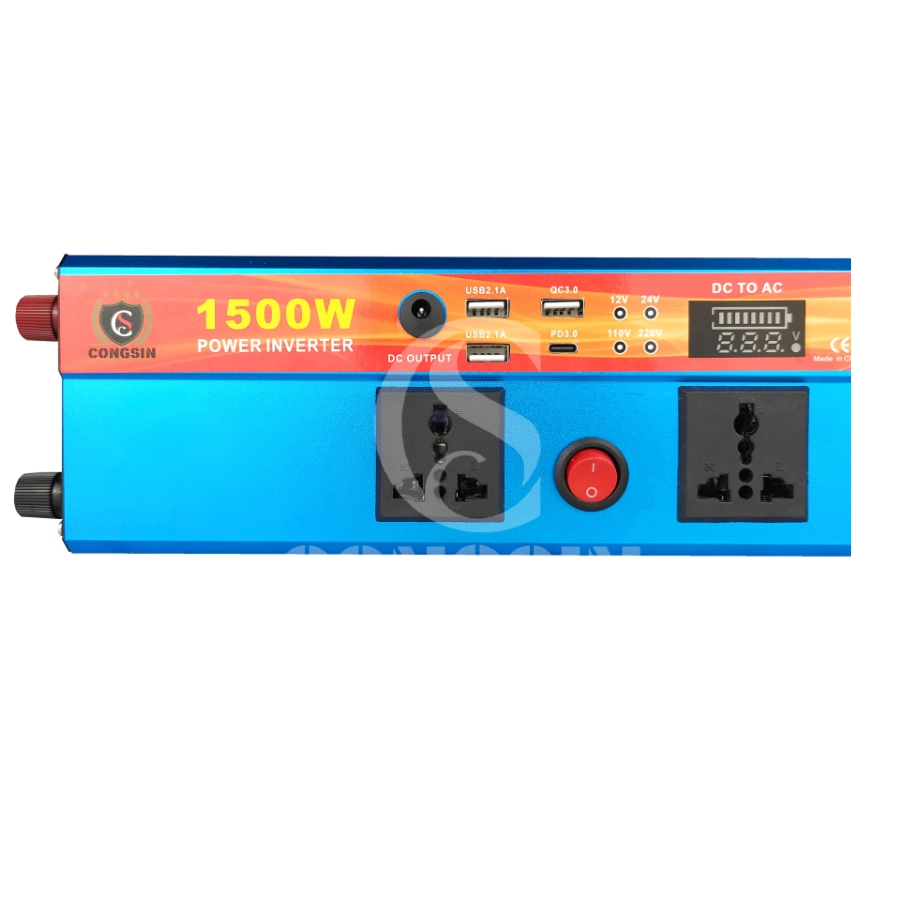
1500W Modified Sine Wave Inverter, DC 12V to AC 220V Power Inverter with LED Display, 3 USB Ports, 1 Type-C, 1 DC 12V Output & Two Universal Sockets
Our CS1000DDBC 1000W modified sine wave inverter is a professional power conversion device that converts DC 12V from batteries into AC 220V electricity. It is designed with user convenience in mind, featuring an LED display for real-time status monitoring, multiple charging ports (3 USB, 1 Type-C, 1 DC 12V) and two universal sockets to power a wide range of devices simultaneously. Its compact size (250×95×55mm) and lightweight design (NW: 0.84kg) make it easy to carry, ideal for outdoor activities, emergency home use, and on-the-go power needs.
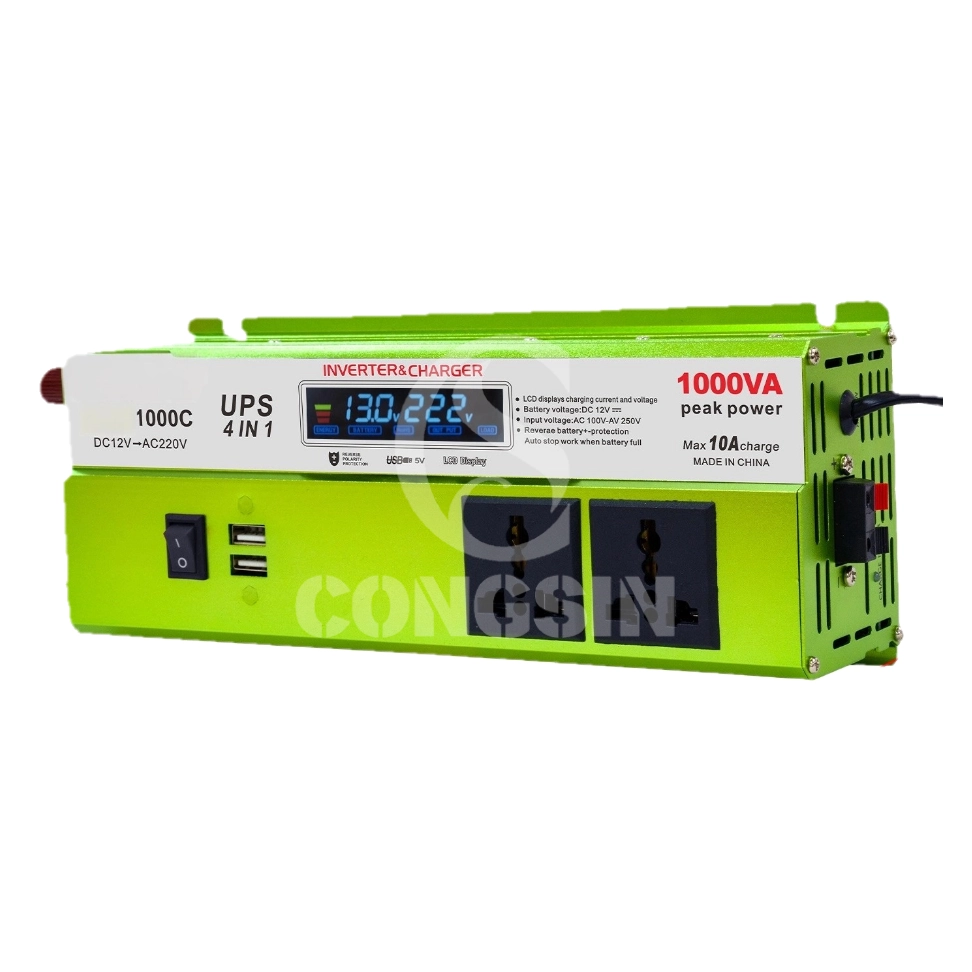
1000W 1500W 2000W UPS POWER INVERTER WITH CHARGER 10A 15A 20A DC TO AC 12v24v 110v 220V
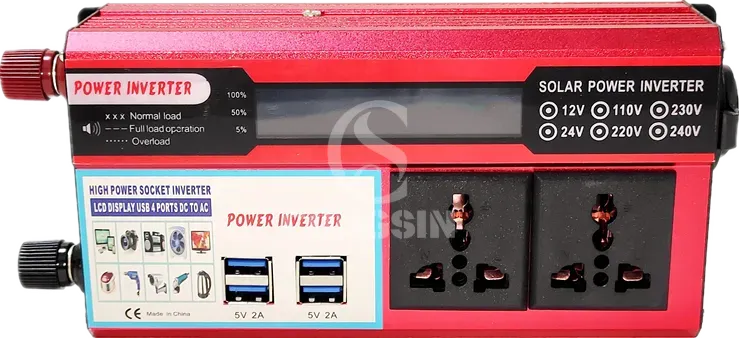
Congsin 500W Modified Sine Wave Inverter with LCD Display of Off Grid System Solar Power Inverter

CONGSIN is a trusted OEM factory for power inverters, solar charge controllers, and DC converters. Reliable solutions for global B2B buyers.
 High Quality
 7/24 Service
 Guaranteed Warranty
© 2025 Congsin. All Rights Reserved.